
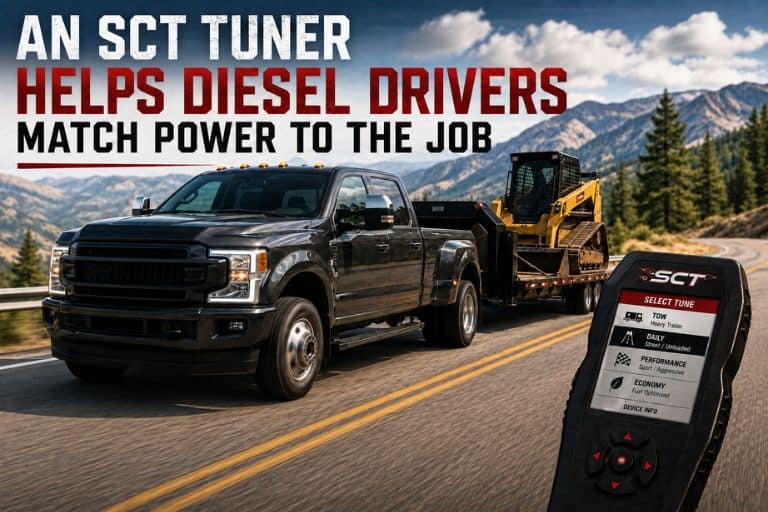
An SCT Tuner Helps Diesel Drivers Match Power to the Job
As an Amazon Associate & Influencer, we earn from qualifying purchases you might make if you click any of the links or buttons on this page.
Diesel owners rarely ask their trucks to do only one thing. The same pickup may tow a skid steer on Monday, commute empty on Wednesday, haul a fifth-wheel through mountain grades on Friday, and idle at a jobsite during a cold morning start. That mix creates a practical problem: one factory calibration has to serve every situation, even when the load, terrain, weather, and driver expectations keep changing.
For business owners, contractors, farmers, and serious weekend haulers, that mismatch can show up in expensive ways. A truck that feels sluggish under load may tempt the driver to stay deeper in the throttle. A transmission that hunts between gears on hills can build heat. Poor throttle response can make merging with a trailer feel less controlled. More power is not always the real goal. The better goal is usable, predictable performance that fits the work in front of the truck.
Diesel Performance Should Match the Load
A heavy-duty diesel is built around torque, but torque needs to arrive in a way the truck can manage. Pulling a loaded equipment trailer through rolling terrain is different from driving empty around town. In towing conditions, smooth power delivery, controlled exhaust gas temperatures, and sensible shift behavior matter more than a dramatic peak horsepower number.
That is where calibration becomes useful. A well-matched tune can sharpen throttle response, adjust fueling, refine transmission behavior, and help the truck hold power more consistently under load. The driver feels the difference not only when accelerating, but also when climbing, passing, and maintaining speed without constant pedal changes.
Seasonal use makes this even more important. Summer towing through high heat can punish cooling systems and transmissions. Winter driving may call for smoother response on slick roads. A truck used for both work and recreation needs enough flexibility to avoid treating every mile like a race or every trip like an empty commute.
The Right Setting Can Protect More Than Speed
Power upgrades often get discussed like bragging rights, but diesel owners who depend on their trucks usually care about uptime first. A failed transmission, overheated engine, or derated truck can cost far more than the price of a performance part. For a small excavation company, one sidelined truck can delay a job, leave equipment stranded, and force a rental at the worst time.
A sct tuner gives drivers a practical way to choose calibrations that better fit how the truck is being used, whether the priority is towing, daily drivability, fuel-conscious cruising, or stronger response for heavier work.
That choice matters because diesel performance is not one-size-fits-all. A tune that feels exciting on an empty road may not be the smartest match for a 12,000-pound trailer on a long grade. Likewise, a conservative towing setup may feel less lively during unloaded driving, but it may keep temperatures and shifting behavior in a safer range when the truck is working hard.
Useful Tuning Starts With Honest Use
Before changing a truck’s calibration, owners should be clear about what the vehicle actually does. A daily driver with occasional light towing has different needs than a service truck loaded with tools, a camper hauler crossing western passes, or a fleet pickup that multiple employees drive.
Towing and Hauling
For towing, the best setup usually favors steady torque, lower stress, and cleaner transmission behavior. The truck should pull confidently without sudden surges that make a trailer harder to manage. Drivers should also pay attention to tire rating, brake condition, cooling system health, and trailer weight. Tuning cannot make an overloaded or poorly maintained setup safe.
Daily Driving
For unloaded driving, improved throttle response and smoother acceleration can make the truck feel less lazy without requiring aggressive power. Many owners want a cleaner, more responsive feel during merging, passing, and stop-and-go traffic. That can be useful, but restraint still matters. Pushing for maximum output on a stock truck can move wear from “someday” to “soon.”
Work Trucks and Fleet Use
For work trucks, consistency is often the biggest win. If employees drive the vehicle, a sensible calibration can help keep performance predictable across different routes and loads. Business owners may care less about peak numbers and more about reducing driver complaints, avoiding unnecessary fuel waste, and keeping the truck ready for the next job.
Supporting Parts Still Matter
A tuner does not erase mechanical limits. Intake restrictions, exhaust setup, turbo condition, injector health, transmission age, and maintenance history all affect the result. A truck with old fluid, weak batteries, clogged filters, or existing fault codes should be corrected before performance changes are made.
Monitoring is also important. Drivers who tow regularly should know what normal temperatures look like and recognize when the truck is working too hard. The smartest diesel upgrades are the ones that improve confidence without hiding warning signs.
Better Control for Real Driving
The main value of smarter tuning is control. Diesel drivers are not all chasing the same number on a dyno sheet. Many simply want their truck to feel right when the trailer is hooked up, the grade gets steep, the weather changes, or the workday runs long.
When calibration matches the job, the truck becomes easier to trust. It pulls with less drama, responds more cleanly, and gives owners a better chance of balancing power, drivability, and long-term reliability. For anyone who relies on a diesel truck to earn money, move equipment, or carry a heavy load safely, that balance is the point.

